
Yemen’s Ansar Allah: From Dominating Bab el-Mandeb to Fueling the Tanker Crisis

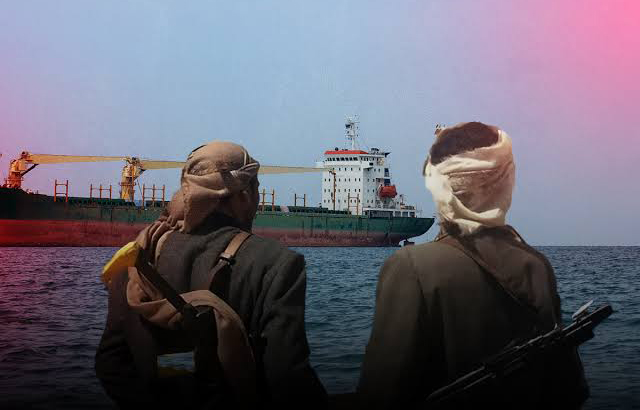
SeaNews — Bab el-Mandeb is nothing new for Yemen’s Ansar Allah. For years, the group has used missiles, drones, and maritime operations to demonstrate that it can target ships in the Red Sea and force major shipping companies to reroute, even without completely shutting down the waterway.
Yemeni forces are no longer limited to striking Bab el-Mandeb from hundreds of kilometers away. Advances along Yemen’s western coast, the capture of the ports of Al-Mokha and Dhubab, and their subsequent reach to the strategic Perim Island (Mayun) have effectively placed Ansar Allah in the heart of one of the world’s most sensitive shipping lanes. In the latest developments, images and field reports published recently reveal the presence of Ansar Allah forces inside a vessel-traffic monitoring tower located in this exact sector.
The Yemenis Have Reached the Route Itself
Perim Island may look small on a map, but it sits right in the middle of Bab el-Mandeb—the exact point connecting the Red Sea to the Gulf of Aden and onward to the Indian Ocean. The island divides the waterway into two channels, meaning that any military force controlling it holds a position immediately adjacent to the maritime transit corridor.
Reuters has confirmed the capture of Perim, Dhubab, and Ansar Allah’s advance along Yemen’s western coast, describing it as a serious development for the security of one of the world’s primary shipping routes. Forces loyal to the Saudi-backed government have also withdrawn from several areas in recent days, prompting Riyadh to resume airstrikes in an attempt to prevent the situation from fully solidifying.
From Hormuz in the East to Bab el-Mandeb in the West
East of the Arabian Peninsula lies the Strait of Hormuz, a waterway that over recent months has once again shown how tightly it is tied to Iran’s management of the strait. Sharp declines in vessel traffic, surging insurance costs, and skyrocketing tanker rates have demonstrated that any shift in the security status of Hormuz directly enters global energy market calculations. On September 10, shipping data showed that only seven vessels had passed through Hormuz, whereas daily traffic volumes were significantly higher before the conflict. On the other side of the Arabian Peninsula, Ansar Allah has now reinforced its position in Bab el-Mandeb.
The picture is as simple as it is critical: Iran on the eastern flank of the Arabian Peninsula and Ansar Allah on the western flank control two choke points through which a massive flow of oil, goods, and global trade passes. To project power in a maritime choke point, you do not always need to plant your flag in the middle of the waterway; sometimes, it is enough to hold the power to decide whether passage is safe or perilous. Iran demonstrated this capability in Hormuz, and now Ansar Allah has moved closer to a position in Bab el-Mandeb where the weight of its decisions carries far more gravity in shipping calculations than ever before.
Saudi Arabia’s Escape Route from Hormuz Also Under Pressure
Perhaps no country feels the pressure of these two converging geographies quite like Saudi Arabia. For years, Riyadh prepared for a day when Hormuz would face a crisis by building an alternative route known as the East–West Pipeline. Spanning roughly 1,200 kilometers, the pipeline carries oil from Saudi Arabia’s eastern production fields to the port of Yanbu on the Red Sea coast. The logic was clear: if exports through the Persian Gulf and Hormuz became difficult, oil would reach the market via western Saudi Arabia.
In recent weeks, the importance of this pipeline surged dramatically. According to Reuters reports, it was carrying roughly four to five million barrels of oil per day—equivalent to nearly 5 percent of global oil supply. However, a recent drone strike forced Saudi Arabia to temporarily suspend operations on the line. Riyadh now faces a glaring geographical paradox: oil can be rerouted away from Hormuz, but the region’s geography cannot be erased. If cargo is diverted to Yanbu, it enters the Red Sea—a body of water whose southern gateway is Bab el-Mandeb, where Ansar Allah now maintains a substantially stronger land and naval position than it did just weeks ago. In short, the route intended as Saudi Arabia’s escape hatch from Hormuz risk has itself entered a zone of escalating political and military risk.
The Associated Press (AP) highlighted this very issue in its recent report, noting that the intensifying pressure in Bab el-Mandeb comes at a time when Saudi Arabia has grown more dependent on the Red Sea route than ever before due to disruptions in Hormuz.
The Maritime Depth of the Resistance Axis
From our perspective, what is unfolding today can be viewed as a new phase in shaping the maritime depth of the Resistance Axis. For years, discussions surrounding this axis focused predominantly on land-based geographies like Iraq, Syria, Lebanon, and Yemen. However, recent developments demonstrate that the weight of the sea in this equation is growing rapidly.
Even now, VLCC crude shipping rates from the Sea of Oman to China have reached unprecedented highs, and the simultaneous crises in Hormuz and the Red Sea have once again pushed oil prices above $100! The global economy must understand and accept that it has no choice but to engage with our country on economic matters and accommodate our powerful nation on political issues. After all, Yemen represents an extension of the Resistance Front’s maritime power, operating under the influence of policies set by powerful Iran as the central ring of this axis.
